
How to Search San Joaquin County Marriage & Divorce Records
The right starting point depends on the record type. For a marriage license or a certified marriage copy, the search runs through the Assessor-Recorder-County Clerk. For a divorce, custody, support, or restraining order, the path is the Superior Court family law division at sjcourts.org. Both can be reached at 180 East Weber Avenue in Stockton.
Online lookups for family law cases use the same two tools as the rest of the court. The party-name search lives at sjcourts.org, and the case-number portal is FullCourt Enterprise. Family law results may be more limited because some family records are sealed. Recorded marriage documents sit in the county recorder index at the Tyler Self-Service portal.
The screenshot shows the family law landing page with division contacts and form packet links.
Marriage Records vs Divorce Records in San Joaquin County
California splits these records by design. Marriage records live with the county recorder. Divorce records live with the trial court. That split is the most important thing to know before paying a fee or showing up at a counter.
The Assessor-Recorder-County Clerk runs the marriage license process, indexes marriage certificates, and sells certified marriage copies. The same office handles birth and death copies. The court has no role in any of that. Divorce, legal separation, annulment, custody, support, paternity, and family law restraining orders are filed at the Superior Court family law division. Judgments in those cases must be ordered from the court, not the recorder.
Note: A marriage certificate proves the marriage took place; a divorce decree proves it ended, and only the court can certify it.
Applying for a Marriage License in San Joaquin County
Couples planning to marry in California must get a license before the ceremony. In San Joaquin County the license is issued by the Assessor-Recorder-County Clerk, not the court. The county marriage license page sets the current appointment rules, ID list, fees, and ceremony scheduling. Both parties must appear together. The license is valid statewide for the period set by California law.
The lead-in sentence here links to the county marriage license information page, which holds the current process detail.
The image shows the County Clerk's marriage license page with the steps and the ID list.
How to Apply for a Marriage License
The steps below walk through the standard path.
- Review the county marriage license page for current rules.
- Confirm both parties meet California marriage requirements.
- Choose between a public license and a confidential license.
- Bring valid government photo ID for both applicants.
- Bring proof that any prior marriage ended, if that applies.
- Pay the current license fee at the counter.
- Receive the license and confirm the validity window.
- Have an authorized officiant perform the ceremony, then return the completed license for recording.
Marriage License Requirements
California sets the core marriage license rules statewide. Both parties must be at least 18, or have a court order if a minor. Both must appear in person at the County Clerk to sign. Valid photo ID is required. There is no waiting period and no blood test.
Common documents and details to plan for:
- Government photo ID such as a driver license, state ID, military ID, or passport.
- Full legal name as it should appear on the certificate.
- Date and place of birth for each party.
- Parents' full names, including a parent's birth name where asked.
- Information about how any prior marriage ended, with a date of dissolution or death.
- Choice of new married name, if either party plans to change it.
Confidential vs Public Marriage Certificates
California offers two license types, and the choice changes who can later order a certified copy. A public marriage record is open and indexed in the regular vital records system. A confidential license is different. The certificate is not part of the public index, and copies are limited to the spouses or a person with a court order.
Confidential licenses are only available to couples already living together. The choice cannot be swapped after the fact, so couples should pick the option that fits the privacy they want before paying for the license.
Getting a Certified Marriage Copy in San Joaquin County
Certified marriage copies are ordered from the County Clerk after the officiant returns the signed license for recording. The county vital records page sets the requester rules, copy fees, and turnaround times. A copy from a marriage performed in another California county must be ordered from that county. Older or out-of-state records may be sourced from the California Department of Public Health.
The lead-in sentence here links to the county vital records page. Plan for ID, a signed sworn statement for authorized copies, and the current fee.
The image shows the vital records landing page, which sets the rules for ordering certified marriage, birth, and death copies.
Marriage License Application Fields
The county application asks for standard biographical details from each applicant. Exact form labels can shift, but the field types are stable. The table below lists the core fields most couples will see.
| Field | Required | Notes |
|---|---|---|
| Full legal name of each applicant | Yes | Name as it should appear on the certificate. |
| Date of birth | Yes | Both parties must be 18 or have a court order. |
| Place of birth | Yes | City, state, and country. |
| Current residence address | Yes | Used for the county record. |
| Parents' full names | Yes | Includes a parent's birth surname where asked. |
| Prior marriage end date and type | If applies | Death, dissolution, or nullity, with date. |
| License type | Yes | Public or confidential. |
| New married name choice | Optional | Either party may change their name through the license. |
| Valid government photo ID | Yes | Driver license, state ID, military ID, or passport. |
Note: The exact online or in-person field list is set by the County Clerk and may differ from the table above; always confirm against the official marriage license page before the appointment.
Filing for Divorce in San Joaquin County
Divorce, legal separation, and nullity are filed at the Superior Court family law division. California is a no-fault state, so a party can ask for divorce based on irreconcilable differences. A six-month waiting period runs from the date the responding party is served before a judgment can take effect. One party must have lived in California for six months and in the county for three months before filing.
The lead-in sentence here links to the official family law forms packet, a starting point for self-represented filers.
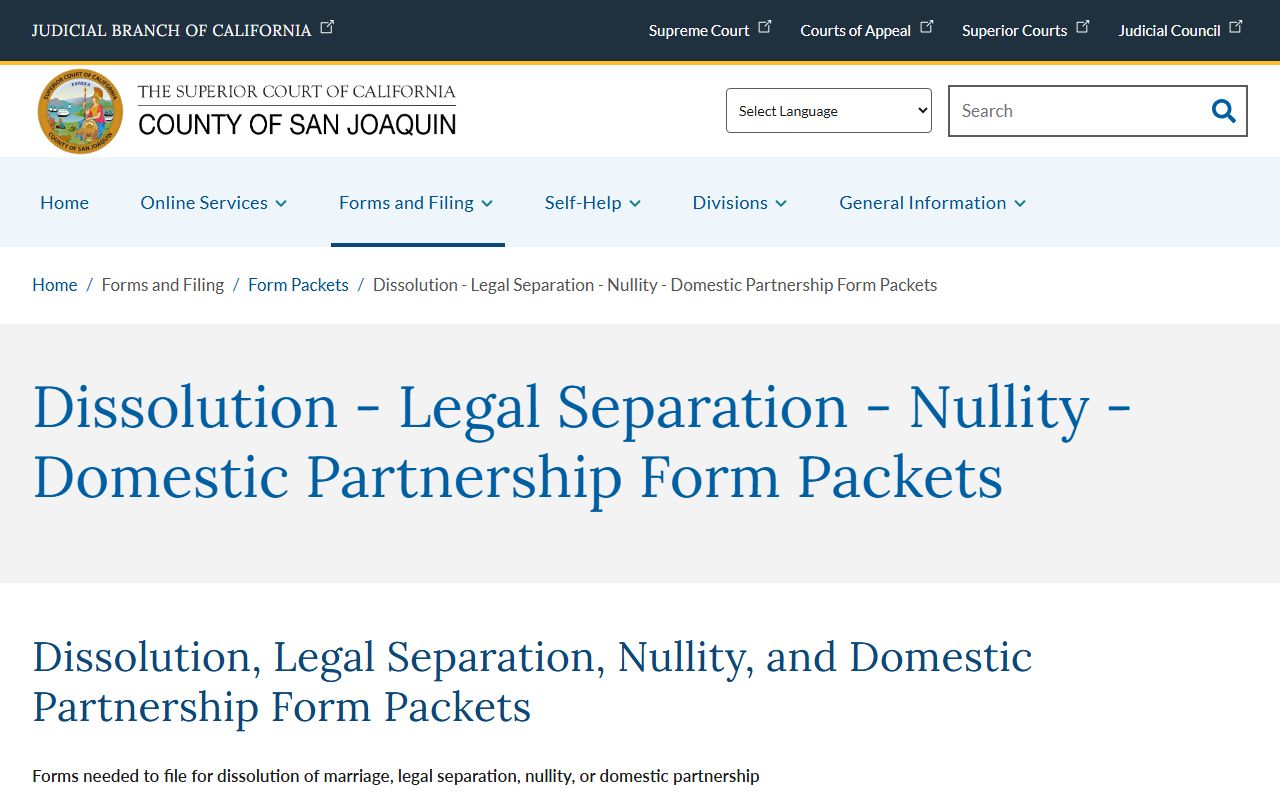
The screenshot shows the court's packet page, which lists Judicial Council forms used to start and finish a divorce case.
How to File for Divorce
The steps below match the standard California path.
- Confirm jurisdiction and residency rules.
- Use the right Judicial Council forms and any local San Joaquin forms.
- File the petition and summons with Superior Court family law in Stockton.
- Pay the filing fee or submit a fee waiver request.
- Serve the other party.
- File the proof of service with the court.
- Exchange financial disclosures.
- Resolve custody, support, property, debts, and any restraining orders.
- Complete the agreement, default, or trial step that fits the case.
- Submit judgment paperwork and request a certified copy.
San Joaquin County Divorce Judgments and Certified Copies
A divorce judgment is the court order that ends the marriage. It also sets custody, support, property, and debt orders. Certified copies of the judgment are ordered from the Superior Court, not the County Clerk. The county recorder does not hold divorce judgments.
To order a certified copy, a requester needs the case number, the party names, and the date range. Records management at the court handles older or off-site files. Some judgments include sealed attachments, so a basic certified judgment may be released while specific exhibits stay restricted.
Note: A judgment that has not been entered yet will not appear in the public index, so check entry status before paying a copy fee.
Domestic Violence and Restraining Orders
Domestic violence, civil harassment, elder abuse, and workplace violence restraining orders are filed at the Superior Court. The family law division hears domestic violence orders involving spouses, partners, or close family. The court self-help center supports parties who file without an attorney.
Standard items in a restraining order file include:
- The request form with the facts the court will weigh.
- Any temporary order issued at the first hearing.
- Proof of service on the restrained party.
- The final order after notice and a hearing.
- Any later modification or renewal order.
- Custody and visitation orders that ride with a family law case.
San Joaquin County Adoption Records
Adoption records in California are confidential by statute. Family Code section 9200 seals adoption files and limits who can view them. The court does not release adoption files through the standard party-name search. Even the parties to the case must follow a specific procedure to view the file.
The order of adoption may be viewed in limited form, and the state issues a new birth certificate after the adoption is final. People seeking adoption file access should consult an attorney or the court self-help office.
San Joaquin County Marriage and Divorce Fees
Marriage license and certified marriage copy fees are set by the County Clerk. Divorce filing, fee waiver, and certified court copy fees are set on the court's fee schedule. Exact dollar amounts shift, so always confirm the live page before sending a check.
| Item | Source |
|---|---|
| Marriage license | County Clerk marriage license page |
| Certified marriage copy | County vital records page |
| ARCC general fee schedule | Assessor-Recorder-County Clerk fees |
| Divorce petition filing | Superior Court fee schedule |
| Certified court copy of judgment | Superior Court fee schedule |
| Fee waiver request | Judicial Council fee waiver forms |
San Joaquin County Forms and Fee Waivers
Family law runs on Judicial Council forms. The main library is at the state courts website. The San Joaquin family law packet page bundles the most common forms for dissolution, legal separation, nullity, and domestic partnership cases. Filers who cannot pay court fees may submit a fee waiver request. The court reviews income and household size before granting it.
Common form sources for these cases:
- Judicial Council of California form library.
- San Joaquin Superior Court family law packet.
- San Joaquin Superior Court local forms for cases that need them.
- County Clerk forms for marriage license applications.
- California Department of Public Health vital records request forms for older records.
Self-Help Resources for San Joaquin County Family Law
People who file without an attorney can use the court self-help center for forms and procedural help. The self-help office does not give legal advice or represent parties. It does explain how to fill in forms, how service works, and how a case moves through the court.
The lead-in sentence here links to the court's self-help center page. It lists family law clinics, domestic violence help, and form workshops.
Note: Self-help staff cannot tell a party what to do, but they can explain options and point to the right form or hearing.
Contact: Assessor-Recorder-County Clerk Office
San Joaquin County Assessor-Recorder-County Clerk
San Joaquin County, California
Marriage licenses, vital records, recorder filings
Superior Court of California, Family Law Division
180 East Weber Avenue
Stockton, CA 95202
Divorce, custody, support, restraining orders