
How to Search San Joaquin County Probate Records
Probate cases in San Joaquin County are searched through the same two tools used for civil cases. The first is the court's party-name search at sjcourts.org/case-management-search. The second is the case-number portal at FullCourt Enterprise. Probate is filed under the Civil case type in the party search, since California groups it that way for public access. A name on a probate file may be the decedent, an heir, a petitioner, a conservatee, or a minor.
To run a party-name search, the user enters at least two of last, first, middle, or company name, picks Civil as the case type, and sets a filed year range. The court explains that California Rule of Court 2.507 limits party searches and that the public search may not include date of birth or driver license fields. A case-number search through FullCourt is faster when the case number is in hand. Older or sealed records may not appear in either tool and may require a records request.
The lead-in sentence here links to the probate of decedents estate form packet, which lists the Judicial Council forms most filers will start with. The packet page is also a good check on local form needs.
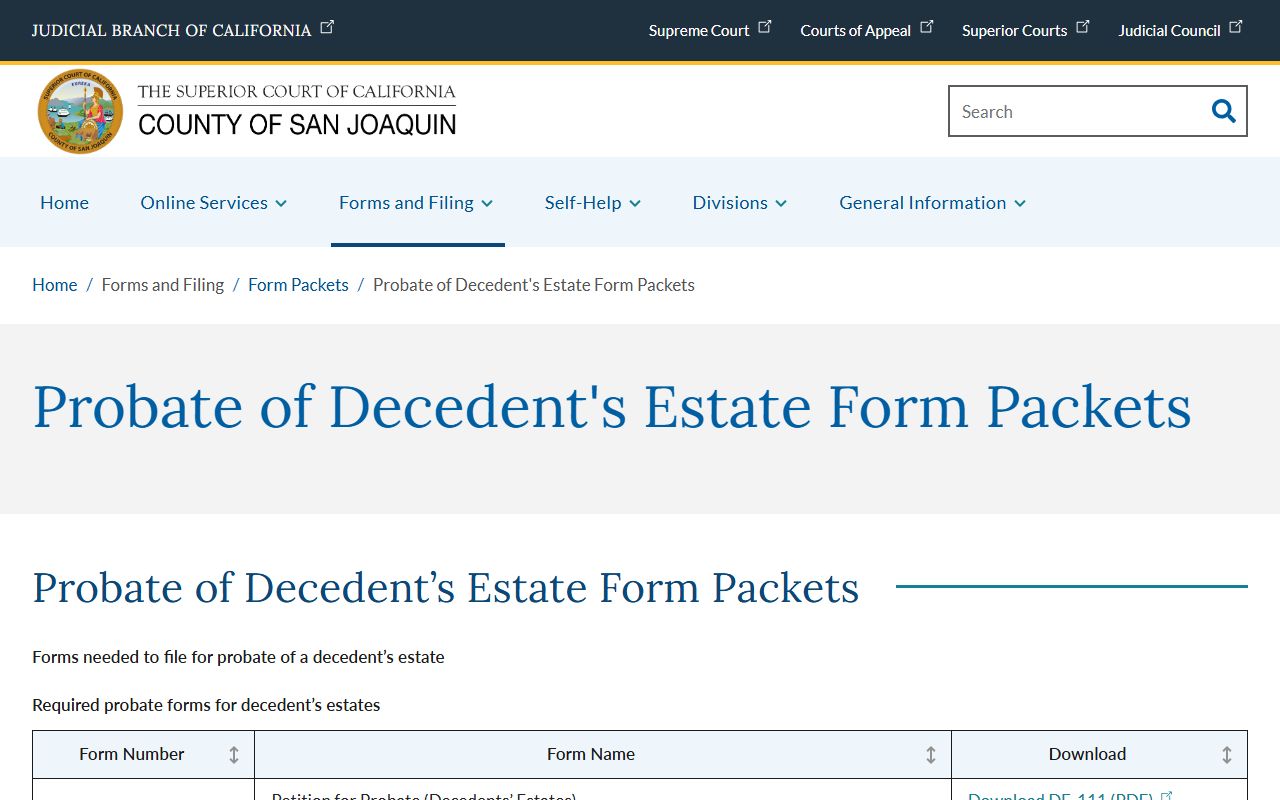
The screenshot shows the probate form packet page. New filers can use it to gather the right Judicial Council forms before going to the court counter.
What San Joaquin County Probate Covers
Probate is wider than just wills. The Superior Court probate division hears a set of related case types that share rules under the California Probate Code. Most users come in for one of three reasons. A relative has died and an estate needs to be opened. A minor needs a legal guardian. Or an adult has lost capacity and needs a conservator.
Common case types handled by the probate division:
- Decedent estates with or without a will.
- Wills and codicils admitted for probate.
- Letters testamentary and letters of administration.
- Trust petitions and trust accountings.
- Guardianships of minors over person, estate, or both.
- Conservatorships of adults, including LPS conservatorships.
- Creditor claims, inventories, and appraisals.
The San Joaquin County Probate Division
The probate division sits within the Superior Court of California, County of San Joaquin. Filings, hearings, and the local probate calendar are managed at the main courthouse in Stockton. The court website holds the official probate division page, division forms, and the form packet for decedent estates. Telephone questions go through the main court switchboard, which routes to the probate clerk.
The lead-in sentence here links to the official probate division page at sjcourts.org. The page is the source of truth for hearing days, local rules, and any temporary procedure changes. The court self-help page is also useful for filers who do not have an attorney.
Superior Court of California, Probate Division
180 East Weber Avenue
Stockton, CA 95202
Contact the court main switchboard
Note: The court website is the official source for any change in probate counter hours, filing windows, or hearing day.
San Joaquin County Probate Filing Steps
A decedent estate is the most common probate filing. The steps below match the California Probate Code path for a formal probate. Some estates qualify for a small-estate procedure and skip parts of this process. A small estate affidavit, a spousal property petition, or a summary procedure may be the right path for low-value estates. Filers should confirm the right route before opening a formal case.
- Decide if formal probate is needed or a small-estate procedure applies under California law.
- Locate the original will and a certified death certificate.
- Prepare the petition and required Judicial Council and local San Joaquin forms.
- File the petition with the San Joaquin Superior Court probate division in Stockton.
- Pay the filing fee or submit a fee waiver request.
- Give statutory notice to heirs, beneficiaries, and other interested persons.
- Attend the first hearing if the court requires it.
- Receive Letters from the court if appointed as personal representative.
- Take inventory of the estate assets and submit the appraisal.
- Notify creditors and process valid creditor claims.
- File the account or a waiver of account where the heirs agree.
- Distribute the assets by court order and close the estate.
San Joaquin County Probate Terms Defined
Probate uses words from the California Probate Code that have a precise meaning. The list below covers the most common terms in a San Joaquin probate file.
- Testator
- The person who made the will.
- Executor
- The person named in the will to carry out its terms.
- Intestate
- Dying without a valid will.
- Intestate succession
- The state's default rules for who inherits when there is no will.
- Letters testamentary
- The court order giving the executor power to act for the estate.
- Letters of administration
- The court order naming an administrator when there is no will or no named executor.
- Guardian
- An adult appointed by the court to care for a minor's person, estate, or both.
- Conservator
- A person appointed by the court to manage an adult who cannot manage their own affairs.
Wills and Letters Testamentary
A will is admitted to probate after a petition is filed and notice is given. The court reviews the will for valid form, signatures, and witnesses. If the will is admitted, the court issues letters testamentary to the named executor. Letters are the proof of authority a bank, broker, or county recorder needs to deal with estate assets. Certified copies of letters are ordered from the court for a fee.
An estate without a will follows the rules of intestate succession. The court appoints an administrator and issues letters of administration. The administrator has the same duties as an executor, but the order of authority is set by statute. Either way, the personal representative gathers assets, pays valid debts, and distributes what is left to the heirs under the court's order.
Guardianships of Minors in San Joaquin County
A guardianship of a minor is filed in the probate division when a non-parent needs legal authority to care for a child. The court may grant guardianship of the person, guardianship of the estate, or both. A guardian of the person makes daily decisions about school, medical care, and housing. A guardian of the estate manages money or property held for the minor. Guardianship requires notice to the parents, the child if old enough, and other close relatives.
Probate guardianship files include the petition, any background screening, the order, and any later report to the court. The minor's address and certain school or health details may be redacted in the public file. The court self-help office at sjcourts.org/self-help supports parties who file without an attorney.
Conservatorships of Adults
A conservatorship is the adult version of a guardianship. The court appoints a conservator for an adult who cannot manage personal care or finances. California has two main types. A general probate conservatorship covers an adult with a disability or cognitive decline. A Lanterman-Petris-Short, or LPS, conservatorship is used in a narrow set of mental health cases and runs on different rules.
Common documents in a conservatorship file:
- The petition that asks the court for a conservator.
- The court investigator's report.
- Any medical or capacity declarations.
- The order appointing the conservator.
- Later accountings of the conservatee's funds.
- Any modification or termination order.
Creditor Claims and Inventories
A personal representative must notify known creditors of the death. Creditors then file a claim with the court within the statutory window. The personal representative reviews the claim, pays it from estate funds if valid, or rejects it for the creditor to sue. Disputes go in front of the probate judge.
The inventory and appraisal are core documents in a decedent estate. The inventory lists every asset under the estate's control. A probate referee, appointed by the state, appraises non-cash assets. The completed inventory is filed with the court and becomes part of the public file, subject to limited redactions. The accounting at the end of the case tracks every dollar in and out of the estate.
Confidential San Joaquin County Probate Materials
Most probate filings are open under California's public access rules, but parts of a probate file are restricted. Medical records, financial account numbers, social security numbers, and minor-specific details are often filed as confidential attachments or are redacted by the court. Conservatorship investigator reports may be sealed. LPS conservatorship files have much tighter access rules under mental health confidentiality law.
Note: A file marked confidential at the counter is not released through the standard party-name search and may require a court order to view.
San Joaquin County Probate Filing Fees
Probate filing fees, copy fees, and certification fees are set on the court's fee schedule. Amounts shift over time, so always confirm against the live page before sending a payment. The court accepts fee waivers for filers who cannot pay.
| Item | Source |
|---|---|
| Probate petition filing | Superior Court fee schedule |
| Guardianship or conservatorship filing | Superior Court fee schedule |
| Certified copy of letters | Superior Court fee schedule |
| Certified copy of order | Superior Court fee schedule |
| Plain copy per page | Superior Court fee schedule |
| Fee waiver request | Judicial Council fee waiver forms |
The lead-in sentence here links to the court fee schedule page. It is the only source the court treats as current for any probate fee.
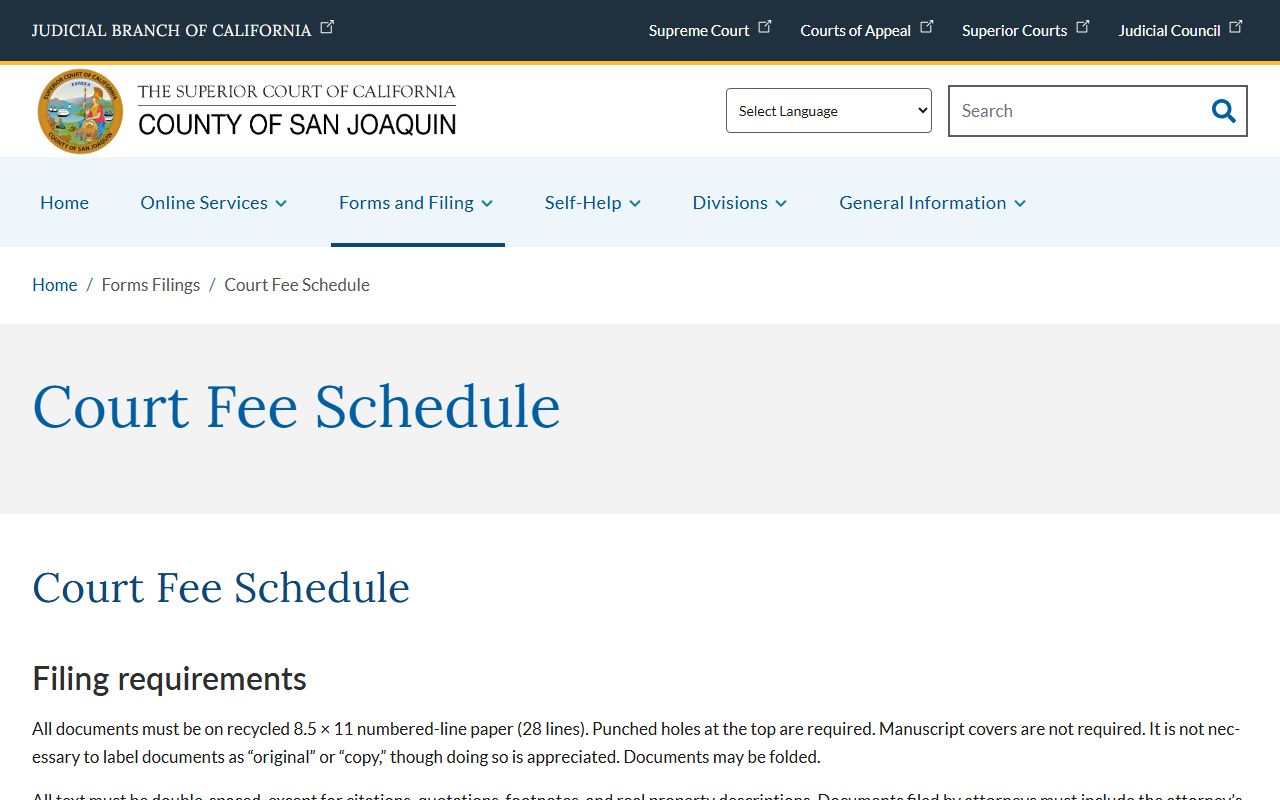
The image shows the court fee schedule page used to confirm probate, guardianship, and copy fees. Always pull the current amount from this page.
Certified Copies of Letters and Orders
Banks, brokers, the county recorder, and other institutions need certified copies of court orders to release estate property. Certified copies of letters, the order admitting a will, and the final order of distribution are the most common requests. The court issues these for a fee. The court fee schedule lists the current copy and certification charges.
Steps to order a certified copy:
- Have the case number ready.
- Confirm the title and date of the order needed.
- Contact the probate division or records management.
- Pay the current copy and certification fee.
- Allow time for mailed requests, which run longer than counter requests.
Self-Help and Forms for San Joaquin County Probate
People who file a probate case without an attorney can use the court self-help center for procedural help and form review. The self-help office does not give legal advice. It does explain how a form should be filled in, how notice works, and how a hearing will run. Many probate matters benefit from an attorney because of the time and money involved.
The lead-in sentence here links to the court's self-help center landing page. The page lists clinics, workshops, and pointers to local legal aid. The state form library at courts.ca.gov/forms.htm holds every Judicial Council form a probate case will need.
Note: Self-help staff cannot tell a party which result to seek, but they can flag missing pages or a missed deadline before a filing is rejected.