
California Public Records Act for San Joaquin County
The California Public Records Act sets the rules for access to county agency records. The Act was recodified into division 10 of title 1 of the Government Code in the early 2020s. Government Code section 7920.000 opens the structure and defines key terms. Government Code section 7922.000 sets the core presumption that public records are open unless an exemption applies.
The Act covers San Joaquin County agencies and special districts. That includes the Sheriff's Office, the District Attorney, the Probation Department, the Assessor-Recorder-County Clerk, the Public Defender, and most county boards. The Act does not apply the same way to court case files. California courts respond under court rules and statutes, not under CPRA. That is why a request for a court case file goes to Superior Court Records Management and a request for a sheriff incident log goes to the Sheriff's Office.
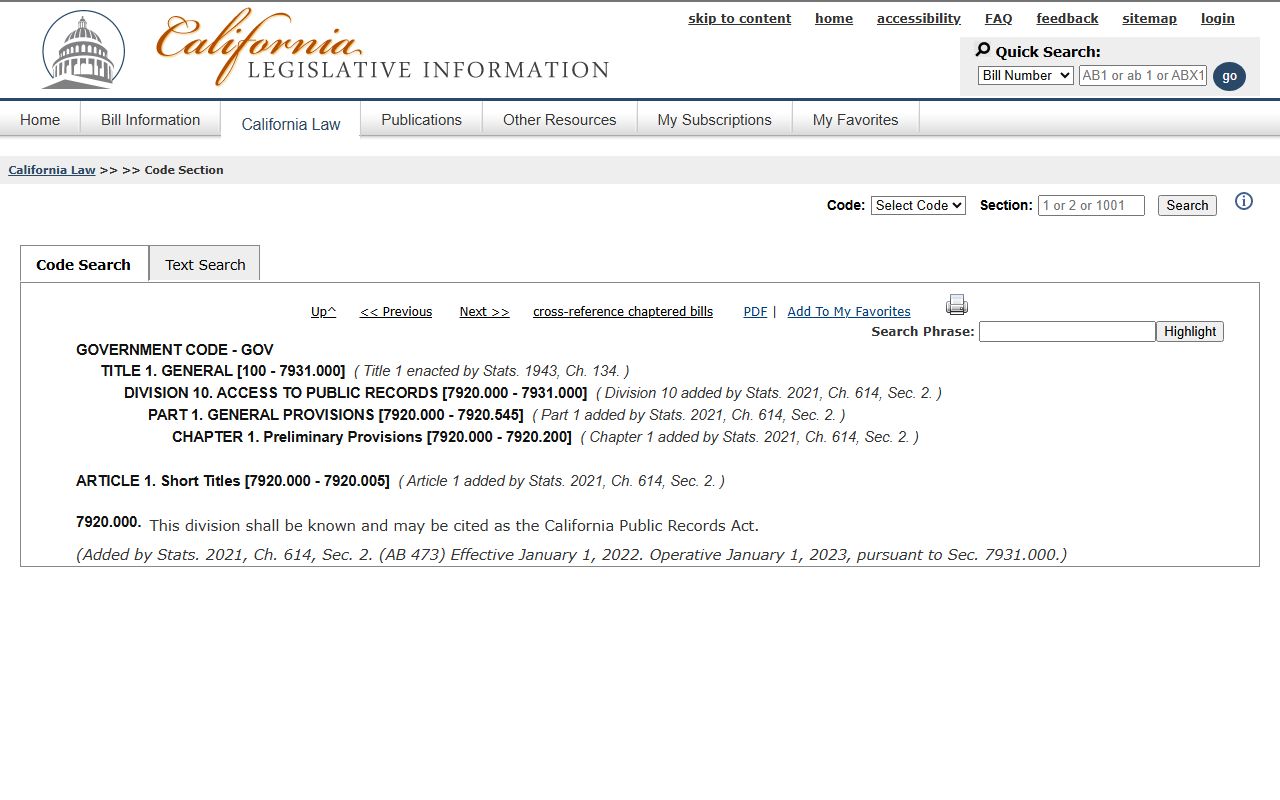
The image below is the official CPRA structure section from the California Legislative Information site. The recodified CPRA in Government Code division 10 is the source you can cite if an agency tries to deny without naming a specific exemption.
Note: Any natural person, business, or organization can ask for San Joaquin County public records under the Act, and there is no requirement to state a reason for the request.
What Records San Joaquin County Offices Hold
San Joaquin County splits its records across several offices. The Assessor-Recorder-County Clerk handles property and vital records. The Sheriff and DA hold law-enforcement and prosecution records. Probation holds supervision and pre-sentence data. The Superior Court holds case files. Knowing the holder cuts request time in half.
The bullets below map each major San Joaquin County office to the public records it controls.
- Assessor-Recorder-County Clerk (ARCC): recorded deeds, deeds of trust, reconveyances, liens, maps, notices, grantor/grantee index, marriage licenses, fictitious business name filings, and certified copies of birth, death, and marriage records.
- Sheriff's Office: arrest reports, jail booking data, custody status, incident logs, and Sheriff administrative records. Custody data is on the Who's in Custody tool. Sheriff Patrick Withrow leads the office.
- District Attorney: prosecution case files within statutory limits, victim/witness program records, and DA administrative records. District Attorney Ron Freitas leads the office.
- Probation Department: supervision records, pre-sentence reports within statutory access rules, and probation administrative records.
- Superior Court Records Management: civil, criminal, family, probate, juvenile, traffic, and small claims case files. Court records run under California Rules of Court, not CPRA.
- San Joaquin County government: Board of Supervisors agendas, county budget documents, ordinances, contracts, and general administrative records.
The ARCC online official records portal is Tyler Self-Service at sanjoaquincountyca-web.tylerhost.net. The portal disclaimer warns that the index is a grantor/grantee search tool, that data can change without notice, and that the index is not a substitute for the recorded document itself.
How to File a San Joaquin County Public Records Request
A CPRA request can be made in writing, by email, or in person. Some San Joaquin departments offer a web form. There is no mandated state form. A clear written request is the safest format because it creates a record of the date and the description.
Use the steps below for a clean request that an agency can act on quickly.
- Pick the right office. Court files go to Superior Court Records Management. Sheriff incident records go to the Sheriff. Recorded deeds go to ARCC. Asking the wrong office wastes time.
- Describe the records with focus. Include party names, dates, case numbers, incident numbers, parcel numbers, or property addresses. Vague requests get vague responses.
- State a date range when possible. A narrow window keeps copy and labor fees down.
- Pick a delivery format. Email, paper copy, electronic file on disc, or inspection at the office.
- Submit the request through the channel the agency lists on its CPRA page. Keep proof of delivery.
- Wait for the agency determination under Government Code section 7922.530. The agency must say whether disclosable records exist within the statutory period, with extensions in unusual circumstances.
- Pay any direct cost of duplication and pick up the records. If the request is denied, ask the agency to cite the specific exemption.
For court records, the request route is different. Use Superior Court Records Management with the case number and the document description. Court copy fees are set by the court fee schedule, not by CPRA labor rules.
San Joaquin Public Records Request Form Fields
A good CPRA request hits a short set of fields. The list below works for almost any San Joaquin County office and matches what agency request forms ask for.
| Field | Required | Notes |
|---|---|---|
| Requester Name | Yes | The CPRA does not require an ID for most requests, but agencies need a name to respond. |
| Contact Method | Yes | Email, phone, or mailing address for the agency response. |
| Description of Records | Yes | Be specific. Include case number, incident number, parcel number, party name, or document title. |
| Date Range | No | A narrow date window speeds the search and lowers any copy or labor cost. |
| Format Preference | No | Paper copy, electronic file, email PDF, or in-person inspection at the agency office. |
| Delivery Method | No | Pick up, mail, email, or secure file transfer if the agency offers it. |
| Fee Waiver Request | No | Some agencies waive small fees; ask if the cost will be material. |
| Purpose | No | Not required under the CPRA. Stating a purpose is optional and does not change access rights. |
The CPRA does not let an agency demand a reason for the request, and it cannot ask for ID for most requests. A request can be made under any name the requester chooses, but the agency must be able to deliver the records back. Keep the contact channel current.
Response Timing Under California Government Code
Government Code section 7922.530 sets the statutory response period. A San Joaquin County agency must determine whether disclosable records exist within the period and tell the requester. Extensions are allowed in unusual circumstances, such as a search across multiple field offices, a need to consult with another agency, or a need to review a voluminous set of records.
The image below is the official text of section 7922.530 from California Legislative Information. The CPRA response timing rule is the citation to use if a county office goes silent past the deadline.
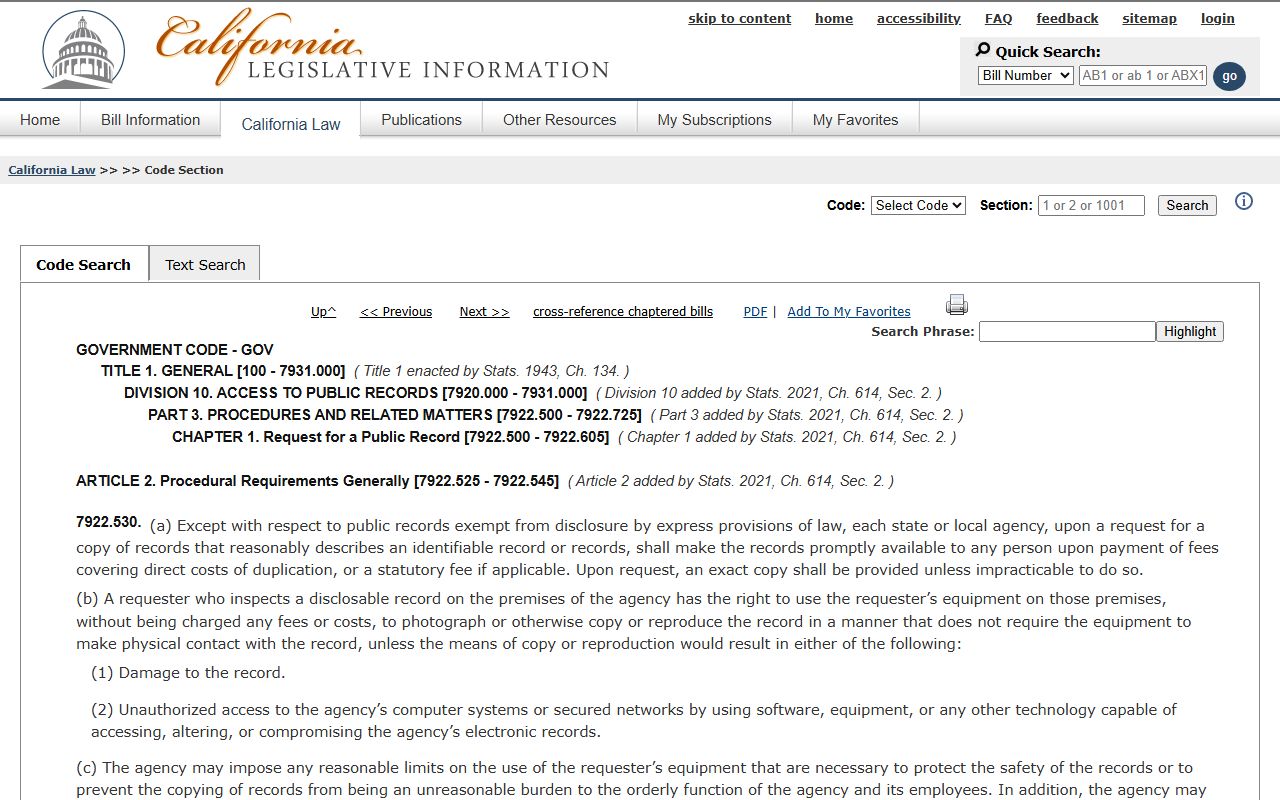
The agency response must do one of three things: produce the records, deny the request and cite the specific exemption, or extend the timeline and explain why. Section 7922.000 puts the burden on the agency to identify an exemption rather than to deny generically. A bare denial without a citation is not a lawful CPRA response.
Note: Court record requests do not follow CPRA timing; they follow Superior Court Records Management procedures and the court's fee schedule.
San Joaquin County Public Records Fees
Fees depend on which office holds the record and which statute applies. The CPRA limits agency charges to the direct cost of duplication for ordinary requests. ARCC sets its recording, copy, and certification fees by statute and county fee schedule. The court sets its copy and certification fees through the Superior Court fee schedule. The table below summarizes the main fee sources for San Joaquin County public records.
| Item | Source / Amount |
|---|---|
| CPRA copy of ordinary agency records | Direct cost of duplication; check the receiving agency for current per-page cost. Electronic delivery is often at no charge. |
| ARCC official record copy | Use the ARCC fees page for the current per-page and certification amount. |
| Marriage license | Use the county marriage license page for current license and ceremony fees. |
| Vital record certified copy | Use the vital records page and the ARCC fees page for current amounts. |
| Superior Court civil, probate, family, and small claims fees | Use the Superior Court fee schedule; amounts vary by filing type. |
| Court record copies and certified copies | Use Records Management with the court fee schedule for current copy and certification cost. |
| Fee waiver | Some agencies waive small charges; the court has a fee waiver process for qualifying civil filings. |
The image below shows the official Assessor-Recorder-County Clerk page. The San Joaquin County ARCC site is the source for recorder copy fees, marriage license cost, vital record certified copy charges, and the recorded document index.
San Joaquin County Public Records That Are Restricted
Not every county record is public. The CPRA carries a long list of exemptions, and other state and federal statutes add to it. A San Joaquin County office can withhold a record when the public interest in nondisclosure clearly outweighs the public interest in disclosure under section 7922.000, but it must say so and cite the basis.
Common restricted categories for San Joaquin County records include juvenile case files under Welfare and Institutions Code section 827, juvenile sealing under section 781, adoption records under Family Code section 9200, sealed arrest records under Penal Code section 851.91, factual innocence relief under Penal Code section 851.8, sealed search warrants and affidavits under Penal Code section 1534, mental health proceedings, medical records, protective-party addresses, financial account numbers, Social Security numbers, ongoing investigation files, and personnel records that fall under specific statutory protections.
Sheriff and DA records sometimes carry investigative or privacy exemptions even when the underlying event is public. Arrest reports are often partially released with redactions. Booking data on the Who's in Custody tool shows current custody, not a complete criminal history. State prison data is held by CDCR, not by the county; federal custody data is held by BOP at bop.gov/inmateloc.
If a San Joaquin Public Records Request Is Denied
A CPRA denial must cite a specific exemption. The first step is to ask the agency to explain the basis in writing. The second step is to narrow or rephrase the request. A broad request that triggered a refusal can sometimes be re-filed in a narrower form that the agency will fill.
If the agency stands by the denial, the requester can seek a writ in the San Joaquin County Superior Court under the CPRA. The court can order disclosure, set fees, and award costs and attorney fees in qualifying cases. Free legal information is available through the court self-help center at sjcourts.org/self-help and through the statewide California Courts Self-Help Guide. The county law library and lawyer referral services can also help with a CPRA challenge.
Note: A writ filing has its own court rules and fees, and the CPRA right is enforceable in San Joaquin Superior Court if the agency will not produce a properly described public record.